Inclusion
 Definition
A school district shall use the term “inclusion” to mean that a student is
receiving education in a general education regular class setting, reflecting natural proportions and age-appropriate heterogeneous groups in core academic and elective or special areas within the school community; a student with a disability is a
valued member of the classroom and school community; the
teachers and administrators support universal education and have knowledge and support available to enable them to effectively teach all children; and a teacher is provided access to technical assistance in best practices, instructional methods, and supports tailored to the student’s needs based on current research. FS1003.57(1)(a)2
Contributing factors to SWD performance gaps
Research has demonstrated that students with disabilities who are fully included
demonstrate higher academic gains than students in traditional settings. In an inclusive classroom, there is an
increase in the amount of instruction on functional activities, basic academic skills, and grade level standards compared to traditional ESE classroom settings. Non-inclusive practices can result in performance gaps.
Benefits of inclusion (
http://www.kidstogether.org/inclusion/benefitsofinclusion.htm)
- Benefits of Inclusion for Students With Disabilities
- Friendships
- Increased social initiations, relationships, and networks
- Peer role models for academic, social and behavior skills
- Increased achievement of IEP goals
- Greater access to general curriculum
- Enhanced skill acquisition and generalization
- Increased inclusion in future environments
- Greater opportunities for interactions
- Higher expectations
- Increased school staff collaboration
- Increased parent participation
- Families are more integrated into community
- Benefits of Inclusion for Students Without Disabilities
- Meaningful friendships
- Increased appreciation and acceptance of individual differences
- Increased understanding and acceptance of diversity
- Respect for all people
- Prepares all students for adult life in an inclusive society
- Opportunities to master activities by practicing and teaching others
- Greater academic outcomes
- All students needs are better met, greater resources for everyone
Resources
Inclusive Education Research and Practice -
http://www.mcie.org/usermedia/application/6/inclusion_works_final.pdf
- Results from placement in a general education classroom include:
- Increase in age-appropriate behaviors
- Increase in the amount of time addressing grade level standards
- Increase in academic achievement
Inclusive Schools Network -
https://inclusiveschools.org/
- Resources to help support inclusion in schools.
Inclusive Schools Week -
https://inclusiveschools.org/inclusive-schools-week/
- Ideas for local school activities to build awareness of inclusion.
NASP Practice Model 10 Domains -
http://bit.ly/2mREmTd
- These 10 practices of school psychologists emphasize an understanding of supporting learning in a highly diverse school environment.
Best Practices for Inclusive Education -
http://www.floridainclusionnetwork.com/school-bpie/
- The School Best Practices for Inclusive Education (BPIE) Assessment is a school self-assessment process designed to identify priority needs, develop goals, plan improvement strategies, and organize resources to support the implementation of inclusive practices for students with disabilities.
School BPIE Indicators At a Glance -
http://www.floridainclusionnetwork.com/wp-content/uploads/2015/03/BPIE-School-Indicators-At-A-Glance-3-5-15.pdf
- A list of the 34 best practices for inclusion school indicators.
Handouts
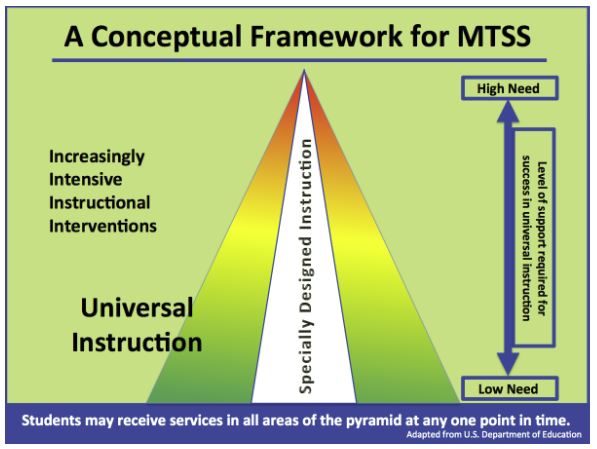
Specially Designed Instruction for Students with Disabilities in a Multi-tiered System of Supports -
http://sss.usf.edu/resources/format/pdf/specially_designed_instruction.pdf
Example action step
- Collecting Data - Every three years Florida schools are required to complete the Best Practices in Inclusive Education (BPIE) assessment.
- Follow Up - Schools and districts can use this information to identify short-term and long-term improvement efforts addressing inclusion, adding a focus on the areas in the school/district with the highest SWD performance gaps.
